Irishdoodle Grooming Guide
The Complete Irishdoodle Dog Grooming & Breed Guide
What is an Irishdoodle? An Irishdoodle — also called an Irish Doodle dog, Irish Setter Poodle mix, or Golden Irish Doodle — is a crossbreed between an Irish Setter and a Standard or Miniature Poodle. The result is a strikingly beautiful, affectionate, and athletically built companion with a wavy-to-curly coat that ranges from deep auburn to golden red and barely sheds.
Why grooming an Irishdoodle is its own discipline: The Irishdoodle inherits the Irish Setter's longer, silkier hair and the Poodle's tight, curl-prone texture. That combination grows fast, tangles in high-friction zones within days, and demands a specific brushing routine that most generic doodle guides simply do not cover. This guide walks you through everything — coat types, schedules, tool comparisons, health flags, and real owner experiences — so you can keep your Irishdoodle looking and feeling their best year-round.

Source: @irishdoodle_sam
What Is an Irishdoodle Dog, and Why Are More Families Choosing This Breed?
The Irishdoodle is a designer hybrid created by crossing an Irish Setter with a Poodle — two AKC-recognized breeds celebrated for very different strengths. The Irish Setter brings elegance, playfulness, and a famously warm temperament. The Poodle contributes intelligence, low-shedding genetics, and remarkable adaptability. Together, they produce the Irishdoodle: a mid-to-large dog with a gorgeous flowing coat, an easy-going personality, and the kind of loyalty that makes them genuinely hard to leave at home.
According to the American Kennel Club, the Irish Setter ranks among the most affectionate and family-friendly sporting breeds in existence, while the Poodle consistently holds its position as one of the top three most intelligent dog breeds in the world. The Irishdoodle inherits both traits in equal measure — and it shows.
The Mini Irish Doodle (Irish Setter × Miniature Poodle) has become especially popular among apartment dwellers and families with smaller living spaces, typically weighing 25–35 lbs compared to the standard Irishdoodle's 40–70 lb range.
Irishdoodle Personality Traits Every Owner Should Understand Before Buying
The Irishdoodle's personality is one of its greatest selling points — and one of its most important management challenges. This is a breed that needs connection, activity, and engagement. Understanding these traits upfront makes the difference between a joyful experience and a frustrating one.
🏃 High-Energy Sporting Dog
The Irish Setter parent was bred for all-day field work. According to PetMD, Irish Setters require at least 60–90 minutes of vigorous exercise per day. Irishdoodles inherit that drive. A bored, under-exercised Irishdoodle will find its own entertainment — and you will not like where it leads.
- Minimum 60 minutes of active exercise daily
- Thrives with fetch, trail runs, and agility
- Best for active owners or families with yards
- Settles well indoors after sufficient exercise
🧠 Intelligent and Eager to Please
Poodle intelligence makes the Irishdoodle one of the most trainable doodle breeds available. Unlike terrier-mix doodles that push back on commands, Irishdoodles genuinely want to get things right. Based on owner reports across Irishdoodle community forums, most puppies learn basic commands within the first two weeks of consistent positive training.
- Responds exceptionally well to reward-based training
- Picks up new commands in 5–15 repetitions
- Needs daily mental stimulation, not just physical
- Excels in obedience, agility, and nose work
❤️ Deeply Affectionate and Social
Irishdoodles are consistently described by owners as "velcro dogs" — they follow their people from room to room and are visibly unhappy when left behind. This is a breed that bonds intensely with the whole family, not just one person. They are excellent with children and typically gentle even with toddlers when properly socialized.
- Outstanding family dog for active households
- Friendly and gentle with young children
- Generally does well with other dogs
- High risk of separation anxiety if undertrained
🎭 Sensitive and Emotionally Tuned-In
The Irish Setter brings a notable emotional sensitivity to the mix. Irishdoodles pick up on tension and mood shifts in their households with remarkable accuracy. They do not respond well to harsh correction and can shut down entirely if training becomes punitive. Positive reinforcement is not just preferred for this breed — it is the only approach that consistently works.
- Never respond to punishment-based training
- Thrive in calm, stable home environments
- Excellent therapy and emotional support dogs
- Start socialization by 8 weeks for best results
Megan from Austin, Texas shared her experience: "Our Irishdoodle Murphy started destroying shoes the second week we had him — not out of spite, but pure boredom. We added a 45-minute morning run and evening puzzle toys, and the destruction stopped completely within three days. He needed a job. Once he had one, he was the calmest dog I've ever owned."
How Much Does an Irishdoodle Puppy Cost, and Where Should You Find Reputable Breeders?
Irishdoodle puppy prices vary based on generation, coat color, breeder reputation, and regional demand. The deep auburn and golden red colorations are in particularly high demand and often command premium pricing. Here is an honest breakdown of what to expect and how to evaluate your options.
| Source | Price Range | What You Get | Our Take |
|---|---|---|---|
| Reputable Irishdoodle Breeders | $1,800 – $3,500 | Health-tested parents, vet checks, socialization, contract, breeder support | Recommended |
| Mini Irish Doodle Specialists | $2,000 – $4,000 | Higher demand, smaller litters — pricing reflects scarcity | Worth the wait |
| Backyard Breeders | $700 – $1,400 | Variable health outcomes, often no OFA clearances or genetic testing | Use caution |
| Pet Store / Puppy Mill Pipeline | $1,200 – $3,000 | High-profit sourcing, typically poor socialization, avoid entirely | Avoid |
| Rescue / Rehome | $150 – $600 | Adult dogs already past destructive puppy phase, often trained | Excellent option |
When searching for Irishdoodle breeders near you, prioritize breeders who can provide OFA clearances for hip dysplasia and progressive retinal atrophy (PRA) on both parent dogs. According to the Orthopedic Foundation for Animals, both Irish Setters and Poodles carry documented genetic health risks that responsible breeding programs actively screen for.

Source: @rio_irishdoodle
Understanding Your Irishdoodle's Coat Type Is the Foundation of Effective Grooming
Not all Irishdoodle coats are the same — and treating them as if they are is the fastest route to chronic matting. The Irishdoodle's coat depends heavily on which parent's genetics dominate and the generation of the cross. Here are the three types you will encounter.
🌊 Wavy / Fleece Coat
Most common in: F1 Irishdoodles (50/50 Irish Setter × Poodle)
Soft, flowing waves with a silky texture inherited largely from the Irish Setter parent. This is the most visually striking coat type — it gives the Irishdoodle its signature auburn-wave appearance — and it is moderately manageable with consistency.
- Low to minimal shedding
- Moderate matting risk (feathering areas and ears)
- Brushing 3–4 times weekly required
- Professional groom every 6–8 weeks
- Beautiful natural movement in the coat
How to identify: Gentle S-shaped waves, especially around the neck, chest, and flanks. Silky to the touch with visible movement when the dog shakes.
🦁 Curly / Poodle-Forward Coat
Most common in: F1B Irishdoodles (75% Poodle)
Tight, Poodle-like curls that are the lowest-shedding and most hypoallergenic option. This coat is ideal for allergy sufferers but demands the most intensive grooming commitment of the three types. The curls trap shed hair within days if not brushed out.
- Virtually zero shedding
- Daily brushing is non-negotiable
- High matting risk within 48–72 hours
- Best choice for severe allergy households
- Professional groom every 4–6 weeks
How to identify: Tight spirals throughout the body that spring back when stretched. Dense and springy — running your fingers through feels like resistance.
🌿 Silky / Setter-Forward Coat
Most common in: Irishdoodles with dominant Irish Setter genetics
Longer, finer, and straighter than the other types — closest to a purebred Irish Setter's flowing coat. It is the least demanding in terms of matting, but it grows quickly and produces the most feathering around the ears, chest, and legs.
- Light shedding (more than curly types)
- Lower matting risk than curly
- Requires brushing 2–3 times weekly
- Feathering on legs needs attention
- Professional groom every 8–10 weeks
How to identify: Flat to slightly wavy, long and flowing — particularly visible on the chest, ears, and leg feathering. Silky and smooth to the touch.
Your Complete Irishdoodle Grooming Schedule, Broken Down by Coat Type
According to PetMD's grooming guidelines, low-shedding dogs require more frequent brushing than heavy shedders because shed hair becomes trapped in the coat rather than falling to the floor. In the Irishdoodle's case, that trapped hair — especially in the longer feathering areas — forms mats at a rate that surprises most first-time owners. The schedule below is built on real brushing frequencies, not optimistic minimums.
| Task | Silky / Setter Coat | Wavy / Fleece Coat | Curly / Poodle Coat |
|---|---|---|---|
| Full Brushing | 2–3× per week | 3–4× per week | Daily (required) |
| Professional Grooming | Every 8–10 weeks | Every 6–8 weeks | Every 4–6 weeks |
| Bathing | Every 5–7 weeks | Every 4–6 weeks | Every 3–4 weeks |
| Nail Trimming | Every 3–4 weeks | Every 3–4 weeks | Every 3–4 weeks |
| Ear Cleaning | Every 2–3 weeks | Every 1–2 weeks | Weekly |
| Teeth Brushing | 3–4× per week | 3–4× per week | 3–4× per week |
| Paw Pad Trim | Every 4 weeks | Every 2–3 weeks | Every 2–3 weeks |
| Face / Eye Trim | Every 5–6 weeks | Every 3–4 weeks | Every 2–3 weeks |
| Feathering Trim (legs, chest) | Every 6–8 weeks | Every 6–8 weeks | Every 4–6 weeks |
| Sanitary Trim | Every 6–8 weeks | Every 4–6 weeks | Every 3–4 weeks |
Claire from Denver told us: "I went on a two-week vacation and left my Irishdoodle Rosie with a dog-sitter who skipped brushing entirely. When I got home, the feathering on her chest and behind her ears was one solid mat. My groomer had to shave her down to about an inch all over. It took six months to grow back. Now I leave a printed brushing checklist with any sitter who watches her."
The Best Grooming Tools for Irishdoodle Dogs — Honest Comparisons, Not Just Promotions
The Irishdoodle's coat is unique: it combines the Irish Setter's longer, silkier strands with the Poodle's tendency toward density and curl. Not every tool performs equally across that spectrum. Based on real owner feedback and hands-on testing, here is how the most common grooming tools actually perform on Irishdoodle coats.
Essential Tools Every Irishdoodle Owner Needs
🖌️ Slicker Brush
The single most important tool for any Irishdoodle owner. Fine, angled pins penetrate the outer coat and detangle the interior without scratching skin. For Irishdoodles, choose a medium-firm slicker with a flexible cushion base — rigid slickers drag uncomfortably through the longer setter-type feathering.
- Works on all three Irishdoodle coat types
- Use before and after every bath
- Pay extra attention to chest, ears, and leg feathering
- Replace when pins begin to bend — bent pins cause breakage
🔩 Metal Comb
A metal comb is your quality-control check after every brushing session. Run it through the coat from root to tip — if it snags, there is still a hidden mat the slicker missed. Many Irishdoodle owners skip this step, then wonder why mats keep appearing days after what seemed like a thorough brush. Do not skip it.
- Use a combination comb (wide-spaced + fine-spaced teeth)
- Run close to skin on ear feathering and leg fringe
- Non-negotiable for curly coat Irishdoodles
- Stainless steel lasts indefinitely — invest once
🧴 Detangling Spray
Brushing a dry Irishdoodle coat — especially the longer silky types — causes friction, static, and coat breakage. A light detangling spray applied 30 seconds before brushing dramatically reduces resistance and protects the coat's natural structure. Look for water-based, silicone-free formulas to avoid product buildup on the setter-type coat.
- Essential for silky and wavy coat Irishdoodles
- Apply lightly before each brush session
- Reduces brushing time by 20–35%
- Especially important during dry winter months
✂️ Dematting Tool
When mats have already formed — and at some point they will — a dematting rake is far more humane than forcing a slicker brush through the tangle. The rake's serrated blades cut through the mat structure without pulling surrounding coat or pinching skin. Every Irishdoodle owner should own one before they need it.
- Work the edges of the mat first, never the center
- Move in the direction of coat growth
- Especially critical for feathering and ear mats
- Do not use on skin-level mats — see a groomer
🐾 Pin Brush (Wavy and Curly Coats)
For wavy and curly Irishdoodles, a pin brush lifts and separates the curl structure without breaking it down. Experienced doodle groomers consistently recommend the same sequence: pin brush first, slicker brush second. Reversing this order causes frizz, breakage, and an uncomfortable brushing experience for the dog.
- Always use before the slicker brush, not after
- Flexible cushion base reduces scalp pressure
- Works best on a slightly damp coat
- Less useful on the silky setter-type coat
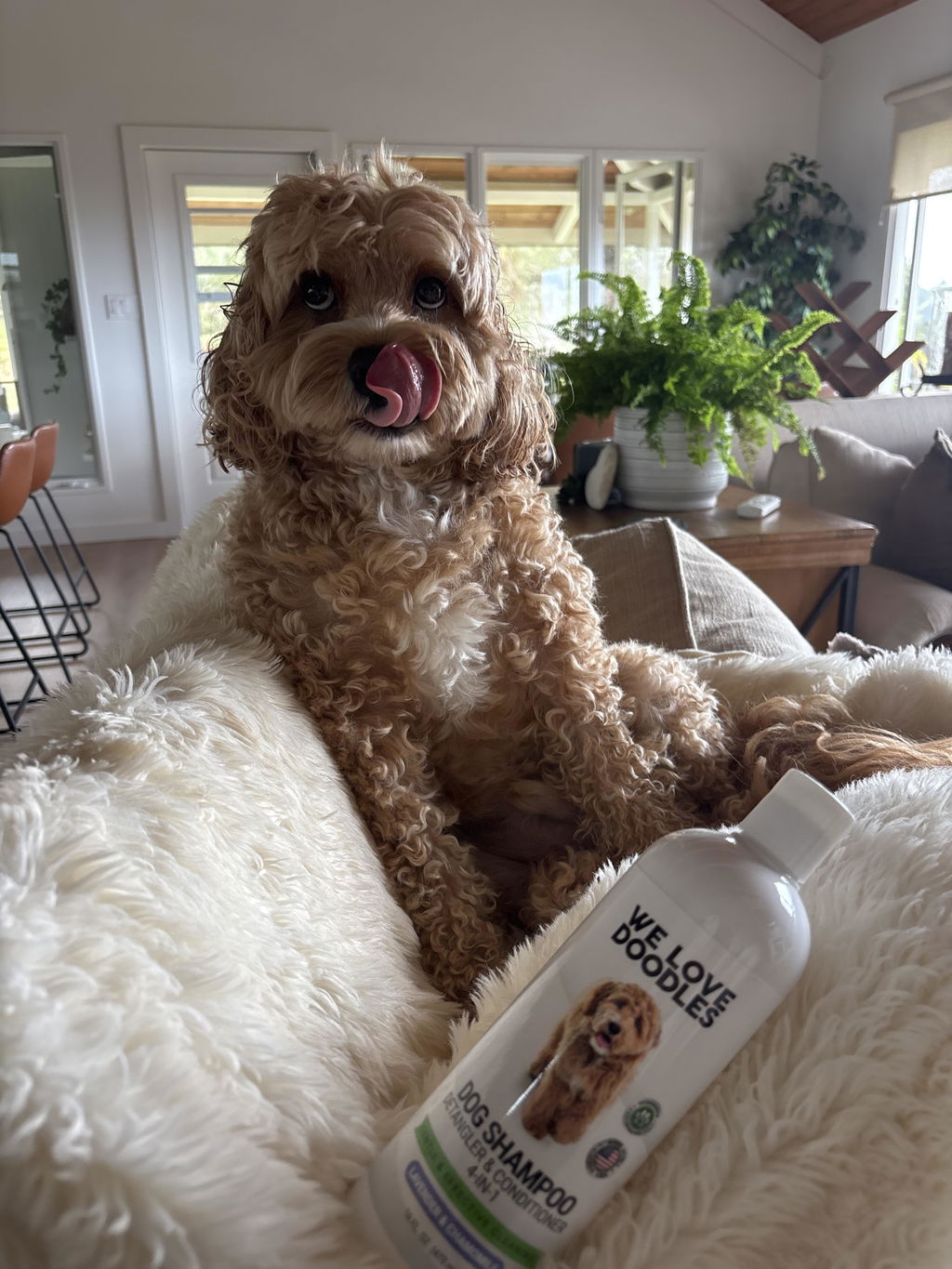
🛁 Shampoo & Conditioner
The Irishdoodle's coat needs a gentle, pH-balanced shampoo formulated for dogs — not humans. Human shampoo sits at pH 5.5, significantly more acidic than a dog's skin pH of 6.2–7.4. Using human shampoo strips the protective oil layer from the Irishdoodle's coat and leads to chronic dryness, especially in the longer feathering. Always follow shampoo with a moisturizing conditioner.
- Use a moisturizing conditioner on every coat type
- Rinse completely — residue causes skin itching
- Dry thoroughly before brushing to avoid breakage
- Hypoallergenic formula if your dog has skin sensitivities
Grooming Tool Budget Tiers for Irishdoodle Owners
Starter Kit
For new Irishdoodle puppy owners getting established
- Medium slicker brush
- Metal combination comb
- Gentle puppy shampoo
- Nail clippers
- Ear cleaning solution
- Detangling spray
Complete Home Kit
For owners handling regular at-home maintenance between grooms
- Professional slicker brush
- Pin brush + comb set
- Dematting rake
- Shampoo, conditioner & detangling spray
- Grooming scissors (blunt-tip + thinning shears)
- Nail grinder
- Tear stain wipes
Full At-Home Pro Kit
For owners doing full trims and haircuts at home
- Professional clippers + multiple blade lengths
- High-velocity force dryer (essential for large coats)
- Complete brush collection
- Premium shampoo and conditioning line
- Professional scissors set (straight, curved, thinning)
- Grooming table with adjustable arm
- Complete nail care system

Source: @irishdoodle_sam
Common Health Issues in Irishdoodle Dogs That Every Owner Should Monitor
Hybrid breeds often benefit from what geneticists call hybrid vigor — a reduction in certain inherited conditions through increased genetic diversity. Irishdoodles are generally healthier than either purebred parent. However, they still inherit documented health predispositions from both the Irish Setter and the Poodle lines. Based on OFA health data and peer-reviewed veterinary research, here are the conditions most commonly reported in Irishdoodle dogs.
🦴 Hip and Elbow Dysplasia
Both the Irish Setter and the Poodle carry documented hip dysplasia risk. The Orthopedic Foundation for Animals (OFA) reports that hip dysplasia affects approximately 12–15% of evaluated Irish Setters — a rate that transfers meaningfully to Irishdoodle offspring when health testing is skipped. Request OFA clearance certificates for both parent dogs from any breeder you evaluate.
- Symptoms: limping, reluctance to rise, hind-end stiffness
- Prevention: maintain lean body weight, limit high-impact play in puppies under 12 months
- Use grooming sessions to check for new stiffness or joint sensitivity
- Treatment ranges from physical therapy to surgical correction
🫀 Bloat (Gastric Dilatation-Volvulus)
Bloat is a life-threatening condition far more common in deep-chested breeds like the Irish Setter. According to research published in the Journal of Veterinary Emergency and Critical Care, large and giant deep-chested breeds face significantly higher bloat risk than other dogs. The Irishdoodle's inherited chest depth puts it in this risk category. Bloat can kill within hours — every Irishdoodle owner needs to know the signs.
- Symptoms: distended abdomen, unproductive retching, restlessness
- Emergency — go to a vet immediately if symptoms appear
- Prevention: avoid exercise immediately before and after meals
- Prophylactic gastropexy is an option — discuss with your vet
👁️ Progressive Retinal Atrophy (PRA)
PRA is a heritable eye disease that causes gradual vision loss and eventual blindness. Both Irish Setters and Poodles carry PRA gene variants. The AKC Canine Health Foundation has funded significant PRA research — DNA testing is available and can identify carriers before breeding. Any reputable Irishdoodle breeder should have PRA clearances on both parents.
- Symptoms: night blindness progressing to full vision loss
- No cure — early detection improves quality-of-life planning
- Check eyes for cloudiness or discharge at each grooming session
- Annual ophthalmic exams recommended for at-risk breeds
🌿 Skin Allergies and Hot Spots
The Poodle line brings a known predisposition to environmental and food allergies. Irishdoodles with this inheritance frequently show allergic responses as itchy, inflamed skin — sometimes developing hot spots under dense coat areas that owners don't notice until they're severe. According to PetMD, poodle-mix breeds are among the most commonly treated for skin allergies in veterinary dermatology practices.
- Symptoms: excessive scratching, paw licking, facial rubbing, skin redness
- Common triggers: grass pollen, dust mites, chicken, grain
- Bathe after prolonged outdoor exposure during high-pollen seasons
- Use hypoallergenic shampoo and consult a vet before diet changes
🦷 Dental Disease
According to PetMD, approximately 80% of dogs show signs of periodontal disease by age three. Irishdoodles are not uniquely high-risk compared to other doodles, but their poodle-inherited dental crowding makes consistent teeth hygiene non-negotiable. Dental disease in dogs is directly linked to heart, kidney, and liver conditions — it is not just a cosmetic issue.
- Symptoms: bad breath, yellow tartar buildup, reluctance to chew hard foods
- Prevention: brushing 3–4 times weekly + annual professional cleanings
- Start dental handling during puppy socialization at 8 weeks
- Dental chews as supplement — not replacement for brushing
🧬 Hypothyroidism
Irish Setters have a documented predisposition to hypothyroidism — an underactive thyroid gland that slows metabolism. The condition is manageable with daily medication but often goes undiagnosed for months because early symptoms mimic normal aging or weight gain. According to the American Animal Hospital Association, hypothyroidism is one of the most underdiagnosed conditions in medium-to-large breed dogs.
- Symptoms: unexplained weight gain, lethargy, coat dullness, skin thickening
- Diagnosis: simple blood panel (T4 thyroid level)
- Treatment: daily oral medication — response is typically excellent
- A sudden change in coat quality can be an early sign — flag it at your vet visit
Common Irishdoodle Grooming Problems and Exactly How to Fix Them
🔴 Problem: Severe Matting in the Chest and Ear Feathering
Why it happens: The Irishdoodle's inherited Irish Setter feathering — long, flowing hair on the chest, ears, and legs — is the single most mat-prone area on the breed. Feathering traps moisture, debris, and shed hair simultaneously. Mats in this zone form within 48–72 hours of missed brushing, faster than virtually any other doodle breed.
- Brush chest feathering and ear feathering every single day — even if you skip the rest of the body
- Apply detangling spray to feathering areas before each brush session
- Use a metal comb after brushing to confirm you reached the skin level
- Ask your groomer to keep feathering trimmed to 2–2.5 inches to reduce tangle surface area
- Remove the collar during supervised indoor time to eliminate friction matting at the neck
- Never attempt to cut or force through a skin-level mat — the skin folds into mats invisibly and is easily cut
👁️ Problem: Tear Staining Around the Eyes
Why it happens: Irishdoodles with wavy or longer facial hair accumulate tears in the fur beneath the inner eye corners, creating the reddish-brown discoloration caused by porphyrins in dog tears. Light-coated Golden Irish Doodles are especially prone to visible staining. Hair growing into the eye itself increases tearing and accelerates the problem.
- Wipe the eye area daily with a soft damp cloth or dedicated tear stain wipes
- Trim the facial hair around the eye corners every 2–3 weeks to remove hair-to-eye contact
- Switch to filtered or distilled drinking water — high mineral content in tap water worsens tear stain formation
- Consult your vet if staining is sudden, severe, or accompanied by eye discharge — may indicate a blocked tear duct or eye infection
- Chronic staining often responds best to a shorter face trim maintained consistently
🦻 Problem: Recurring Ear Infections
Why it happens: Irishdoodles inherit the Poodle's hair growth inside the ear canal alongside the Irish Setter's floppy, low-ventilation ear structure. Together, these create a warm, dark, moist environment that is practically ideal for yeast and bacterial overgrowth. Curly-coated and wavy-coated Irishdoodles have the highest ear infection rates of any doodle type.
- Inspect ears weekly — look for redness, dark discharge, unusual odor, or wax excess
- Clean with a veterinarian-recommended ear cleaner every 1–2 weeks (weekly for curly coats)
- Ask your groomer to trim or pluck ear canal hair at every appointment
- Dry ears completely and immediately after every bath or outdoor water exposure
- See your vet within 24 hours if you notice head shaking, scratching at ears, or any foul odor — ear infections worsen rapidly
🐾 Problem: Paw Hair Overgrowth and Ice Ball Formation
Why it happens: Hair grows quickly between and beneath the paw pads of Irishdoodles — particularly on curly-coated dogs. Overgrown paw hair causes slipping on hardwood floors, collects ice and snow into painful balls in winter, and traps outdoor debris that can embed in the pads. Most owners do not notice the problem until the dog is visibly slipping or favoring a paw.
- Trim paw pad hair every 2–3 weeks year-round — increase to every 10–14 days in winter
- Use blunt-tipped scissors and gently spread the pads apart to expose all hair growth
- Trim flush with the pad surface, or just slightly below, for maximum traction
- Check for embedded debris, cracking, or redness while trimming
- Apply paw balm monthly — year-round for dry climates, more often in winter salt season
Tom from Minneapolis shared: "Our Irishdoodle Scout used to wipe out on our kitchen floor every single morning. We thought it was just hardwood being slippery. Our groomer pointed out that the hair between his pads was half an inch long — essentially like putting him on roller skates. One paw trim later, the slipping stopped completely. It took about 10 minutes."

Source: @rio_irishdoodle
How to Adjust Your Irishdoodle's Grooming Routine Across All Four Seasons
🌸 Spring
- Increase brushing to daily during spring coat transition
- Schedule a spring trim as temperatures climb — especially important for curly coats
- Bathe more frequently to remove pollen from coat
- Check leg feathering after every walk for burrs and grass seeds
- Begin flea and tick prevention protocol
☀️ Summer
- Keep coat at 1.5–2 inches to prevent overheating
- Never shave below ½ inch — the coat insulates against sunburn
- Rinse paws after walks on hot pavement to prevent pad burns
- Increase bath frequency if dog swims regularly
- Groom in a cool, shaded area to reduce heat stress during the process
🍂 Fall
- Allow coat to grow to 2–3 inches in preparation for winter insulation
- Check feathering after every outdoor walk for burrs and plant matter
- Schedule a pre-winter professional grooming appointment
- Increase brushing frequency to manage coat transition matting
❄️ Winter
- Keep paw pad hair very short to prevent ice ball formation
- Rinse and dry paws after every walk — road salt causes painful cracking
- Use leave-in conditioner to combat winter dryness on longer coat types
- Ensure complete drying after every bath before allowing outdoor exposure
- Consider protective dog boots for extended outdoor activity
Frequently Asked Questions About the Irishdoodle Dog Breed
The following questions represent the most common searches about Irishdoodles. Each answer is direct and based on breed research, veterinary sources, and real owner experience.
What is an Irishdoodle dog?
An Irishdoodle is a designer crossbreed created by mating an Irish Setter with a Poodle (Standard or Miniature). The breed combines the Irish Setter's warm, athletic, family-oriented temperament with the Poodle's intelligence and low-shedding genetics. Irishdoodles typically weigh 40–70 lbs (Standard) or 25–35 lbs (Mini Irish Doodle) and have a lifespan of 10–13 years. They are not AKC-recognized as a purebred, but both parent breeds are AKC-registered. Common names include Irish Doodle dog, Golden Irish Doodle, and Irish Setter Poodle mix.
What are the typical grooming needs for an Irishdoodle?
Irishdoodle grooming needs depend on coat type. Curly-coated Irishdoodles require daily brushing and professional grooming every 4–6 weeks. Wavy coats need brushing 3–4 times per week and professional grooming every 6–8 weeks. Silky setter-type coats need brushing 2–3 times weekly and professional grooms every 8–10 weeks. All Irishdoodles require weekly ear checks, monthly nail trims, and teeth brushing 3–4 times per week. The feathering on the chest, ears, and legs is the highest-risk mat zone and needs daily attention regardless of overall coat type.
What are common health issues in Irishdoodle dogs?
The most commonly reported health issues in Irishdoodle dogs include hip and elbow dysplasia, bloat (gastric dilatation-volvulus), progressive retinal atrophy (PRA), skin allergies, dental disease, and hypothyroidism. Both parent breeds — Irish Setters and Poodles — carry documented genetic health risks, which is why OFA health testing on breeding parents is essential. Annual veterinary visits, a high-quality diet, healthy body weight, and regular grooming health checks are the most effective prevention strategy. Many Irishdoodles live long, healthy lives thanks to hybrid vigor.
How much daily exercise does an Irishdoodle require?
Irishdoodles require a minimum of 60–90 minutes of vigorous exercise per day, based on the Irish Setter parent's sporting breed energy level. This is higher than many other doodle breeds. Irishdoodles do best with two dedicated exercise sessions — a longer morning activity (run, hike, fetch) and an evening walk or play session. Mental stimulation through training games and puzzle toys is equally important. A chronically under-exercised Irishdoodle will develop destructive behaviors, excessive barking, or anxiety. After age 4–5, most Irishdoodles mellow slightly but still need consistent daily activity.
Where can I find reputable Irishdoodle breeders near me?
Start your search with the AKC Marketplace's parent breed clubs — the Irish Setter Club of America and the Poodle Club of America both maintain ethical breeding standards and can provide referrals. Search for breeders who can provide OFA clearances for hip dysplasia and PRA on both parent dogs, offer health guarantees in a written contract, allow facility visits, and have active waitlists. Avoid any breeder with puppies always available, no health testing documentation, or unwillingness to answer detailed health questions. Irishdoodle rescue organizations and doodle-specific adoption networks are also worth checking for adult dogs.
What are the best grooming services for Irishdoodle puppies?
The best grooming experience for Irishdoodle puppies starts with a "puppy intro groom" — a short, positive first appointment focused on desensitization rather than a full haircut. Look for groomers with specific doodle breed experience who use positive reinforcement handling. Avoid groomers who use restraint loops as a primary control method. For the first groom, ask for a bath, blow-dry, nail trim, and a light tidy — save the full haircut for around 5–6 months when the puppy is more settled. Consistent early grooming appointments every 6–8 weeks from puppyhood create adult dogs that tolerate — and often enjoy — the grooming process.
What is the difference between an F1 and F1B Irishdoodle?
An F1 Irishdoodle is a first-generation cross — 50% Irish Setter and 50% Poodle. F1s typically have wavy or mixed coats and moderate shedding reduction. An F1B Irishdoodle is a first-generation backcross — usually 75% Poodle and 25% Irish Setter — produced by breeding an F1 Irishdoodle back to a Poodle. F1Bs have tighter, curlier coats with minimal to no shedding, making them the preferred choice for allergy households. F1Bs also require the most intensive grooming commitment. A Mini Irish Doodle can be either F1 or F1B, depending on whether a Miniature Poodle is used in the cross.
Do Irishdoodle dogs shed a lot?
No. Irishdoodles are a low-shedding breed, with F1B curly coats being virtually shed-free. However, "low-shedding" does not mean "no maintenance." Shed hair in low-shedding dogs gets trapped in the coat rather than falling on furniture — which means it must be brushed out regularly or it compacts into mats. Irishdoodles are well-suited to allergy-sensitive households, particularly F1B lines, though no dog breed is entirely hypoallergenic. Regular bathing also helps reduce dander, which is the primary allergen trigger rather than hair itself.
Is the Irishdoodle a good family dog?
Yes — the Irishdoodle is an outstanding family dog for active households. They are affectionate, patient with children, generally good with other dogs when socialized early, and deeply loyal to their people. The key qualifier is activity level: an Irishdoodle in a sedentary household will become a problem dog through no fault of its own. Families who walk, run, hike, or play actively outdoors will find the Irishdoodle a near-perfect companion. First-time dog owners can succeed with this breed by committing to consistent training from puppyhood and budgeting adequate time for both exercise and grooming.