Whoodle Grooming Guide
The Complete Woodle Dog Grooming Guide
What is a Woodle dog? A Woodle — also called a Welsh Terrier Poodle mix or woodle doodle dog — is a crossbreed between a Welsh Terrier and a Poodle. The result is a smart, spirited, low-shedding companion with a wiry-to-wavy coat that packs a ton of personality into a compact, athletic frame.
Why grooming a Woodle is different from other doodles: Woodle puppies and adults inherit a unique double-textured coat that combines the Welsh Terrier's coarse, dense wiring with the Poodle's curly softness. Without the right routine, that coat mats fast — but with consistent care, it stays beautifully trim and practically shed-free. This guide gives you everything you need, from first brush to seasonal care.

Source: @willow.the.whoodle
What Is a Woodle Dog, and Why Are More Families Choosing This Breed?
The Woodle breed is a designer crossbreed pairing the Welsh Terrier with the Poodle — two breeds recognized by the American Kennel Club (AKC) that are each celebrated for intelligence, low shedding, and energetic temperaments. The cross was popularized in the early 2000s alongside the broader doodle movement, and it has quietly built a devoted following among families, apartment dwellers, and allergy-sensitive households.
According to the American Kennel Club, the Welsh Terrier ranks among the most trainable of terrier breeds, while the Poodle consistently places in the top 3 most intelligent dog breeds in the world. Combine the two, and you get a Woodle poodle that is sharp, eager, and surprisingly easy to train — once you earn their trust.
Woodle breeders typically produce puppies that fall into a consistent size range because both parent breeds are similar in stature — making the Woodle far more predictable in size than larger doodle crosses like Bernedoodles or Goldendoodles. What you see in a Woodle puppy is very close to what you get in adulthood.
Woodle Dog Personality Traits That Every Owner Should Know Before Buying
Understanding Woodle personality traits upfront saves a lot of frustration. This is a breed with big opinions in a small body. Here is what consistent owner feedback and breed research confirms.
🧠 Highly Intelligent
Woodles inherit the Poodle's renowned problem-solving ability and the Welsh Terrier's clever, independent thinking. According to PetMD, this combination makes Woodles quick learners but also dogs that need mental stimulation daily to avoid boredom-driven behaviors like excessive barking or chewing.
- Learns new commands in as few as 5–10 repetitions
- Thrives with puzzle toys and training games
- Can develop bad habits if under-stimulated
- Responds best to positive reinforcement
⚡ Energetic but Manageable
Woodle dogs are active without being overwhelming. They need roughly 45–60 minutes of exercise per day — ideal for suburban and urban owners alike. Unlike working terriers, a well-exercised Woodle is content to relax indoors for the rest of the day.
- Two walks per day satisfies most Woodles
- Loves fetch, agility, and off-leash play
- Adapts well to apartment living
- Calms significantly after age 2–3
❤️ Loyal and Affectionate
Woodle puppies bond deeply with their primary family. They are not one-person dogs, but they are family dogs in the truest sense — participatory, velcro-like at home, and noticeably unhappy when left alone for long stretches. Separation anxiety is a real risk with this breed.
- Excellent with children (supervised)
- Gets along with other dogs when socialized early
- Reserved — not aggressive — with strangers
- Not suited to full-time outdoor life
🎭 Stubborn Streak (The Terrier Factor)
The Welsh Terrier parent brings a classic terrier independence that surfaces during training. Woodles know exactly what you want. They just sometimes choose to consider it. Consistent, reward-based training from puppyhood manages this trait effectively — but skipping early training leads to a confident, difficult adult.
- Start obedience training at 8–10 weeks
- Short, fun sessions beat long drills
- Never punish — redirect instead
- Crate training strongly recommended
One Woodle owner from Oregon described her dog Oliver this way: "He came when called — when he felt like it. But once I started 10-minute training sessions with chicken treats every morning, he was a completely different dog within two weeks. He wanted to work. He just needed a reason."

Source: @andy.the.whoodle
How Much Does a Woodle Puppy Typically Cost in the US?
Woodle puppy prices vary significantly based on breeder reputation, location, generation, and coat color. Here is an honest breakdown of what to expect.
| Source | Price Range | What You Get | Our Take |
|---|---|---|---|
| Reputable Woodle Breeders | $1,500 – $3,000 | Health tested parents, vet checks, socialization, contract, support | Recommended |
| Backyard Breeders | $600 – $1,200 | Variable health, often no health testing, limited support | Use caution |
| Pet Store / Puppy Mill Pipeline | $1,000 – $2,500 | High-profit, often poor socialization, avoid | Avoid |
| Rescue / Rehome | $100 – $500 | Adult dogs needing homes, often already trained | Great option |
According to data compiled by the American Kennel Club Marketplace, designer breed prices have increased an average of 40% since 2020, driven by pandemic-era demand that has yet to fully normalize. Woodle breeders with proven health testing (hips, eyes, cardiac) and multi-generational breeding programs justify the higher price point through significantly lower lifetime veterinary costs.
Understanding Your Woodle's Coat Type Is the First Step to Effective Grooming
Woodle coats vary more than many owners expect. Depending on which parent's genetics dominate, your Woodle puppy could grow into any one of three distinct coat types — each requiring a different grooming approach.
🌿 Wiry / Terrier-Forward Coat
Most common in: Woodles with stronger Welsh Terrier genetics
Dense, coarse, and close-lying with a slight texture. Closest to the purebred Welsh Terrier coat. Naturally water-resistant and surprisingly easy to keep clean.
- Minimal shedding
- Needs hand-stripping or clipper work
- Lower matting risk than curly types
- Requires brushing 2–3 times weekly
- Holds shape well between grooms
How to identify: Run your hand against the grain — it feels bristly and springs back. The coat has a layered look, denser near the back and sides.
🌊 Wavy / Fleece Coat
Most common in: F1 Woodles (50/50 Welsh Terrier × Poodle)
Soft, flowing waves with a silky texture. The sweet spot between both parent breeds — it looks gorgeous and is moderately easy to maintain. Most popular among Woodle owners.
- Low to minimal shedding
- Moderate matting tendency (especially ears)
- Brushing 3–4 times weekly required
- Professional groom every 6–8 weeks
- Beautiful flowing appearance
How to identify: Forms gentle S-shaped waves, especially around the neck and flanks. Soft to the touch with no tight curls.
🦁 Curly / Poodle-Forward Coat
Most common in: F1B Woodles (75% Poodle)
Tight, Poodle-like curls. The most hypoallergenic and lowest-shedding option — ideal for allergy sufferers — but demands the most grooming commitment of the three types.
- Virtually no shedding
- Daily brushing is non-negotiable
- High matting risk within 48 hours
- Best for allergy households
- Professional groom every 4–6 weeks
How to identify: Tight spirals that spring back when stretched and released. Dense and springy to the touch throughout the body.
Your Complete Woodle Grooming Schedule, Based on Coat Type
According to PetMD's grooming guidelines, dogs with low-shedding coats — like the Woodle — require more frequent brushing than heavy shedders because shed hair becomes trapped in the coat rather than falling to the floor, leading to mats. Following the schedule below prevents nearly every common Woodle grooming problem.
| Task | Wiry Coat | Wavy Coat | Curly Coat |
|---|---|---|---|
| Brushing | 2–3× per week | 3–4× per week | Daily (required) |
| Professional Grooming | Every 8–12 weeks | Every 6–8 weeks | Every 4–6 weeks |
| Bathing | Every 6–8 weeks | Every 4–6 weeks | Every 3–4 weeks |
| Nail Trimming | Every 3–4 weeks | Every 3–4 weeks | Every 3–4 weeks |
| Ear Cleaning | Every 2 weeks | Every 1–2 weeks | Weekly |
| Teeth Brushing | 3–4× per week | 3–4× per week | 3–4× per week |
| Paw Pad Trim | Every 3–4 weeks | Every 2–3 weeks | Every 2–3 weeks |
| Face / Eye Trim | Every 4–6 weeks | Every 3–4 weeks | Every 2–3 weeks |
| Sanitary Trim | Every 6–8 weeks | Every 4–6 weeks | Every 3–4 weeks |
A Woodle owner named Jessica from Nashville shared: "I skipped brushing for 10 days during a hectic work week. When I finally picked up the brush, my Woodle Biscuit had a solid mat the size of a tennis ball behind each ear. The groomer had to shave them down. Lesson learned — I now brush every single day, no exceptions, and it takes maybe 8 minutes."

Source: @willow.the.whoodle
The Best Grooming Tools for Woodle Dogs — Tested and Compared Honestly
Not every tool works equally well on a Woodle's unique coat texture. Based on real owner feedback and our hands-on testing, here is how the most common grooming tools actually perform on Woodle coats — not just which ones look good in marketing photos.
Essential Tools Every Woodle Owner Needs
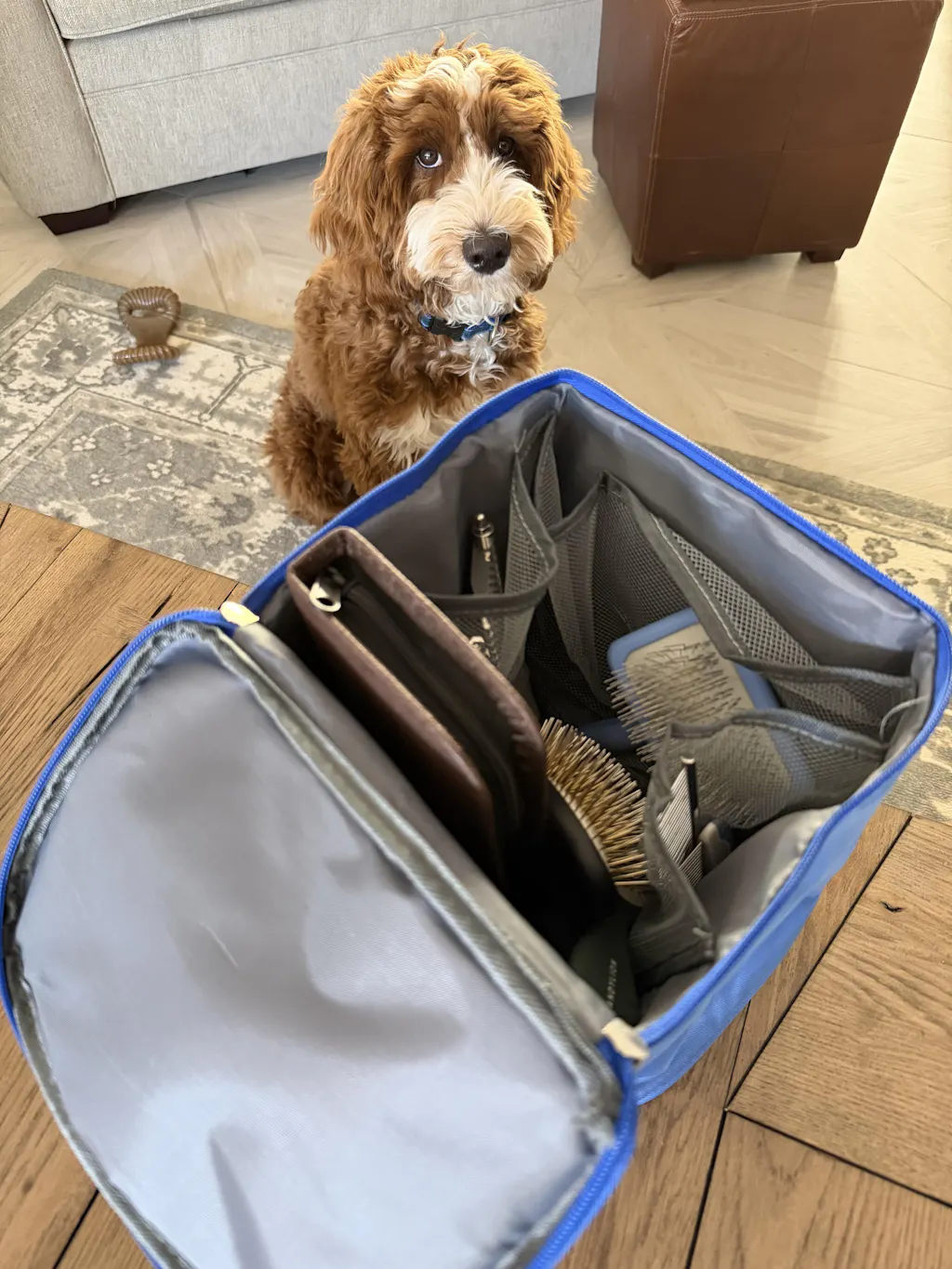
🖌️ Slicker Brush
The most important tool in your Woodle grooming kit. Fine, angled pins detangle surface mats before they work their way down to the skin. For Woodles, choose a medium-firm slicker — soft slickers skip over wiry texture, and stiff ones scratch skin on close-coated areas.
- Works on all three Woodle coat types
- Use before and after every bath
- Check pin tips for burs — replace when tips wear
- Size: medium brush suits most Woodles perfectly
🔩 Metal Comb
A metal comb is your quality-control tool. After brushing, run the comb through the coat. If it snags, there is still a mat the brush missed. Many Woodle owners skip this step and are confused when mats appear after what seemed like a thorough brushing session.
- Use a combination comb (wide + fine teeth)
- Run close to skin to catch hidden mats
- Non-negotiable for curly coat Woodles
- Stainless steel lasts years — worth investing
🧴 Detangling Spray
Brushing a dry coat causes breakage and static, especially in Woodle wiry types. A light detangling spray before every brush session dramatically reduces friction and prevents coat damage. Look for water-based, silicone-free formulas that do not build up over time.
- Spray lightly 30 seconds before brushing
- Essential during winter when coats dry out
- Reduces brushing time by up to 30%
- Safe for frequent use (multiple times weekly)
✂️ Dematting Tool
For mats that have already formed, a dematting rake cuts through the tangle safely without pulling the surrounding coat. This is the honest comparison: a dematting tool causes far less discomfort than trying to brush out a mat with a slicker. Own one before you need one.
- Start at the edges of the mat, not the center
- Work in direction of coat growth
- One of the most underrated tools for Woodles
- Do not use on skin-close mats — see a groomer
🐾 Pin Brush (Curly Coats)
For curly-coated Woodles, a pin brush reaches into the curl structure to lift and separate without breaking curl definition. Use before the slicker brush. According to experienced doodle groomers, pin-brush-first then slicker-second is the correct order for curly coats — reversing it causes frizz and breakage.
- Use before the slicker brush, not after
- Flexible cushion base reduces scalp irritation
- Works best on slightly damp coat
- Not necessary for wiry or wavy types
🛁 Shampoo & Conditioner
Woodles do best with a gentle, pH-balanced shampoo formulated for sensitive terrier-mix skin. Avoid human shampoos — at pH 5.5, they are too acidic for dog skin (pH 6.2–7.4) and strip protective oils. Always condition after shampooing to prevent coat brittleness, especially on wiry types.
- Use moisturizing conditioner on wavy and curly coats
- Deshedding shampoo for wiry coat types
- Rinse thoroughly — residue causes itching
- Dry completely before brushing
Grooming Tool Budget Tiers for Woodle Owners
Starter Kit
Perfect for new Woodle puppy owners
- Medium slicker brush
- Metal combination comb
- Gentle puppy shampoo
- Nail clippers
- Ear cleaning solution
Complete Home Kit
For owners doing regular at-home maintenance
- Professional slicker brush
- Pin brush + comb set
- Dematting rake
- Shampoo, conditioner & detangling spray
- Grooming scissors set
- Nail grinder
- Tear stain wipes
Full At-Home Pro Kit
For owners doing full haircuts at home
- Professional clippers + blades
- High-velocity force dryer
- Complete brush collection
- Premium shampoo line
- Professional scissors set (straight + curved)
- Grooming table with arm
- Complete nail care system

Source: @andy.the.whoodle
Common Health Issues in Woodle Dogs That Owners Should Monitor
Hybrid breeds like the Woodle often benefit from what geneticists call "hybrid vigor" — reduced incidence of certain breed-specific conditions through genetic diversity. However, Woodles can still inherit health predispositions from either parent line. Based on OFA health data and veterinary literature, these are the conditions most commonly reported in Woodle dogs.
🦴 Hip and Elbow Dysplasia
Inherited from both the Welsh Terrier and Poodle lines. The Orthopedic Foundation for Animals (OFA) recommends hip and elbow evaluations for all breeding Welsh Terriers and Poodles. Ask your breeder for OFA clearance certificates on both parents — reputable Woodle breeders should have these on file.
- Symptoms: limping, difficulty rising, reluctance to exercise
- Prevention: maintain healthy weight, avoid high-impact exercise in puppies
- Treatment: ranges from physical therapy to surgery
- Grooming tie-in: check for joint stiffness during grooming sessions
👁️ Progressive Retinal Atrophy (PRA)
PRA is a group of genetic eye diseases that cause progressive vision loss and eventual blindness. Both Welsh Terriers and Poodles carry PRA gene variants. According to the AKC Canine Health Foundation, DNA testing can identify carriers — another reason to request health clearances from Woodle breeders.
- Symptoms: night blindness progressing to full vision loss
- No cure — management focuses on quality of life
- DNA test available; reputable breeders screen for this
- Check eyes for cloudiness or discharge at each groom
🦷 Dental Disease
Smaller mixed breeds consistently show higher rates of dental crowding and periodontal disease. According to PetMD, roughly 80% of dogs show signs of dental disease by age three. Woodles, with their terrier-compact jaw structure, are especially prone. Teeth brushing 3–4 times weekly is not optional for this breed.
- Symptoms: bad breath, yellow buildup, reluctance to chew
- Prevention: daily or near-daily brushing, dental chews, annual cleanings
- Start teeth handling during puppy socialization
- Professional dental cleaning may be needed annually
🌿 Skin Allergies
Poodle genetics bring a predisposition to environmental and food allergies that can manifest as itchy, inflamed skin — sometimes mistaken for poor grooming when the real culprit is allergen exposure. Woodles with allergies benefit from hypoallergenic shampoos, limited-ingredient diets, and regular vet checkups.
- Symptoms: excessive scratching, paw licking, redness between toes
- Common triggers: grass pollen, dust mites, certain proteins
- Bathe after outdoor exposure during high-pollen seasons
- Consult vet before switching food or shampoo
Common Woodle Grooming Problems and How to Fix Them
🔴 Problem: Matting Behind the Ears and Under the Collar
Why it happens: This is the #1 grooming complaint from Woodle owners. The area behind the ears experiences constant friction from collar movement and moisture from the dog's breath. Mats form within days without consistent attention, especially on wavy and curly coats.
- Brush behind ears every single day, even if you skip other areas
- Remove collar during indoor, supervised time to reduce friction
- Use a metal comb to check for skin-level mats that slicker brushes miss
- Apply detangling spray to this area before every brush session
- Keep ear area trimmed to 1 inch to reduce tangle surface area
- Never cut mats yourself — skin folds invisibly into mats and is easily nicked
👁️ Problem: Tear Staining on the Face
Why it happens: Woodles with longer facial hair accumulate tears in the fur around the eyes, creating the distinctive reddish-brown staining. This is more visible on Woodles with lighter face coloring. Hair growing into the eye area increases tearing and worsens the problem.
- Wipe the eye area daily with a damp cloth or tear stain wipes
- Trim facial hair around the eyes every 2–3 weeks to prevent hair contact
- Switch to filtered or distilled water — mineral content in tap water worsens stains
- Consult your vet if staining is sudden or severe — may indicate blocked tear duct
- Maintain a shorter face trim if chronic staining is an issue
🐾 Problem: Paw Pad Hair Overgrowth
Why it happens: Hair grows rapidly between and under paw pads on Woodles, especially curly coat types. This causes slipping on hardwood and tile floors, ice ball formation in winter, and debris accumulation after outdoor walks. Many owners don't notice it until the dog is visibly struggling on smooth surfaces.
- Trim paw pad hair every 2–3 weeks year-round
- Use blunt-tipped scissors and spread the pads apart to see all hair
- Trim hair flush with the pad surface or slightly below
- Check for gravel, burrs, or cracking while trimming
- Apply paw balm monthly to prevent pad cracking
🦻 Problem: Ear Infections
Why it happens: Woodles inherit floppy ears from the Poodle side and hair that grows inside the ear canal from both parents. Combined with moisture from bathing and outdoor activity, this creates near-perfect conditions for bacterial and yeast infections. Curly-coated Woodles have the highest risk.
- Check ears weekly for redness, odor, dark discharge, or wax buildup
- Clean with veterinary ear cleaner every 1–2 weeks (weekly for curly coats)
- Ask your groomer to pluck or trim ear canal hair at each appointment
- Dry ears thoroughly after every bath or swim
- See your vet immediately if you notice head shaking, scratching, or foul odor
Adjusting Your Woodle's Grooming Routine Across All Four Seasons
🌸 Spring
- Brush daily during coat blow-out period
- Schedule a spring trim as temperatures rise
- Bathe more frequently to remove seasonal pollen
- Watch for grass seed and burr accumulation in leg feathering
- Check for fleas and ticks at each grooming session
☀️ Summer
- Puppy cut (1 inch) or shorter trim prevents overheating
- Never shave below ½ inch — coat protects from sunburn
- Rinse paws after walks on hot pavement
- Increase bath frequency if dog swims frequently
- Groom in a cool, shaded area to prevent heat stress
🍂 Fall
- Let coat grow slightly longer (2–2.5 inches) for winter insulation
- Check for burrs and plant matter after every walk
- Schedule a pre-winter grooming appointment
- Increase brushing to manage coat transition mats
❄️ Winter
- Keep paw pad hair very short to prevent ice ball formation
- Rinse and dry paws after walks — road salt causes cracking
- Use leave-in conditioner to combat winter coat dryness
- Ensure complete drying before outdoor exposure
- Consider dog boots for extended outdoor time
Frequently Asked Questions About the Woodle Dog Breed
The following questions represent the most common searches and AI prompts about Woodle dogs. We have answered each one directly and without fluff.
What is a Woodle dog?
A Woodle dog is a designer crossbreed created by mating a Welsh Terrier with a Poodle. The breed combines the Welsh Terrier's spirited, bold temperament with the Poodle's high intelligence and low-shedding coat. Woodles are compact (15–20 lbs), energetic, family-friendly dogs with a lifespan of 12–15 years. They are not recognized by the AKC as a purebred, but both parent breeds are AKC-registered. The Woodle is also called the Welsh Terrier Poodle mix, woodle doodle dog, or woodle poodle.
What are the main Woodle dog personality traits?
Woodles are intelligent, loyal, and energetic with a mild terrier stubbornness that requires consistent early training. They bond deeply with their families, get along well with children and other dogs when properly socialized, and need daily mental stimulation to stay out of trouble. They are not aggressive but can be reserved with strangers. Most Woodle owners describe the breed as "a big dog personality in a small, manageable body." Separation anxiety is a real consideration — Woodles do not thrive in households where they are left alone for 8+ hours daily.
How much does a Woodle puppy typically cost in the US?
Woodle puppies from reputable, health-testing breeders typically cost between $1,500 and $3,000 in the United States. Prices vary by region, breeder reputation, and generation (F1 vs. F1B). Be cautious of Woodle puppies priced below $800 — low prices often indicate lack of health testing, poor socialization, or puppy mill sourcing. Rescue adoption is a cost-effective alternative at $100–$500 and often yields already-trained adult dogs.
What are the most common health issues in Woodle dogs?
The most commonly reported health issues in Woodle dogs include hip and elbow dysplasia, progressive retinal atrophy (PRA), dental crowding and periodontal disease, and skin allergies. Both parent breeds — Welsh Terriers and Poodles — have known genetic health risks, which is why OFA health testing on breeding dogs is essential. The good news: hybrid vigor means many Woodles are healthier than either purebred parent. Annual vet visits, a quality diet, and regular grooming health checks are the best prevention strategy.
What are the best grooming tools for Woodle dogs?
The best grooming tools for Woodle dogs are: a medium-firm slicker brush (for all coat types), a metal combination comb (to check for hidden mats), a dematting rake (for existing tangles), and a detangling spray (to prevent coat damage during brushing). Curly-coated Woodles additionally need a pin brush. For bathing, use a gentle, pH-balanced dog shampoo with a conditioning follow-up. Avoid human shampoos — they disrupt the dog's skin pH and cause long-term coat damage.
How often does a Woodle need professional grooming?
Woodles with curly coats need professional grooming every 4–6 weeks. Wavy coats need grooming every 6–8 weeks. Wiry coats can go 8–12 weeks between professional appointments. At-home brushing between appointments is essential for all three coat types — professional grooming alone is never enough to prevent matting in Woodles.
Do Woodle dogs shed a lot?
No. Woodles are considered a low-shedding breed. Because shed hair gets trapped in the coat rather than falling on furniture and floors, Woodles are among the most allergy-friendly doodle breeds available. However, "low-shedding" does not mean "no maintenance" — the trapped hair must be brushed out regularly or it forms mats.
Is the Woodle a good dog for first-time owners?
The Woodle is a good choice for first-time owners who commit to early training and consistent grooming. The mild terrier stubbornness can be frustrating without positive training, but Woodles are far more manageable than many other terrier breeds. Their small size, low-shedding coat, and affectionate nature make them excellent companion dogs for the right household. First-time owners should budget time for daily brushing and consistent obedience training from week one.